Area 5 · Upper Arms (North)
The shallow north end above the Marina and North Pointe ramp. Mostly under 30 ft; the spawning and fall end of the lake. analysis
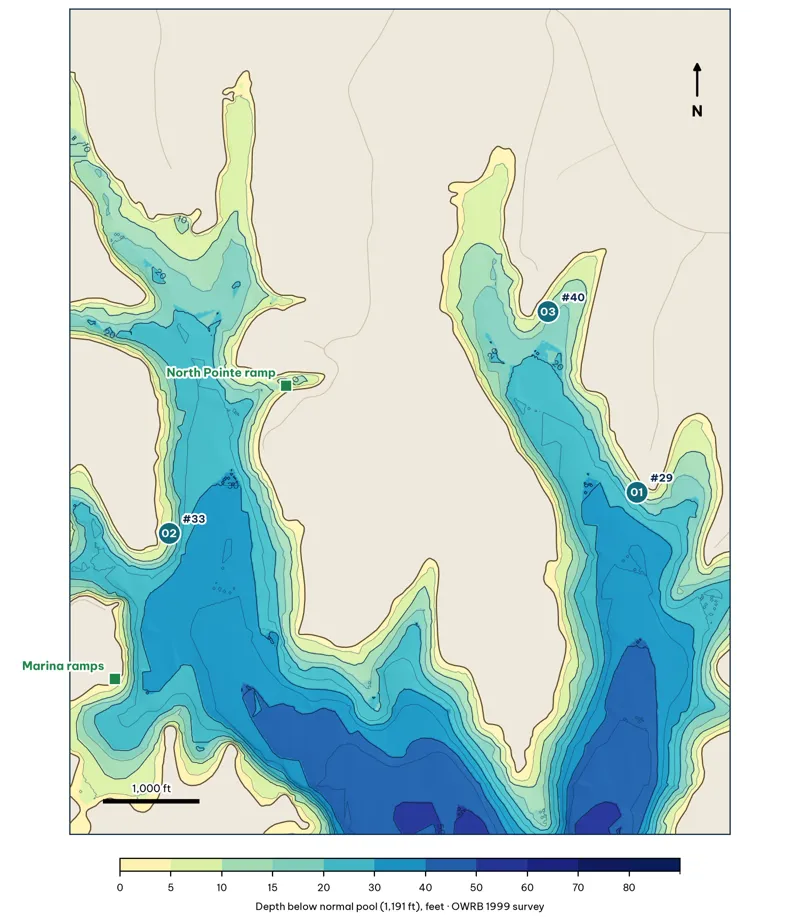
Area 5. Badge number = spot ID within the area; "#" = lake-wide giant rank. Red = score 80+, orange = 70–79, teal = under 70. Contours every 10 ft (labeled) from the OWRB 1999 survey grid.
Area 5 Spots: Upper Arms (North)
3 spots: A5-01, A5-02, A5-03. Close-up maps from the OWRB 1999 survey; scores from the giant ranking.
A5-01 · Point (SW-facing)
#29 of 40Deep water3Cover3Forage3Low pressure4Data4Best: Pre-spawn · Spawn · Summer · Fall
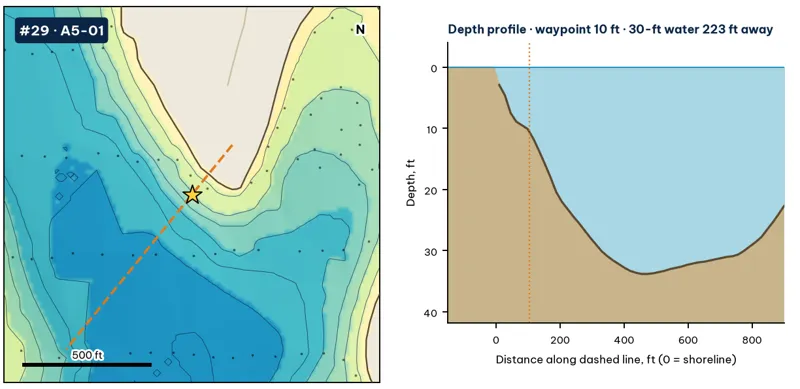
Star: target waypoint. Dashed orange line: the profile on the right. Black dots: OWRB 1999 sonar soundings. Contours every 5 ft from my grid of those soundings and OWRB's contours. Depths are below the 1,191-ft normal pool.
| Measure | Value |
|---|---|
| Depth at the waypoint | 10 ft analysis |
| Deep-water access | 20-ft water 75 ft away · 30-ft 223 ft · 40-ft 1515 ft · deepest within 300 ft: 34 ft analysis |
| Slope | 8.6 ft per 100 ft (10 ft to 30 ft) analysis |
| Data support | 10 soundings within 300 ft analysis |
Why a giant would use it. A main-lake point with 30-ft water close to the bank. Points are the natural highways between the deep channel and the coves. Pre-spawn females stage on them, and wind-blown shad pile up on them in summer and fall. inference
How to fish it. Jerkbait and jig in pre-spawn; Texas-rigged worm and deep crankbait in summer; swimbait on windy days inference. Best wind: from the SW (blowing onto the spot) analysis. Oklahoma City's prevailing wind is south to southeast for most of the year, so south-facing banks get it most often (OCS).
A5-02 · Point (E-facing)
#33 of 40Deep water3Cover3Forage3Low pressure2Data5Best: Pre-spawn · Spawn · Summer · Fall
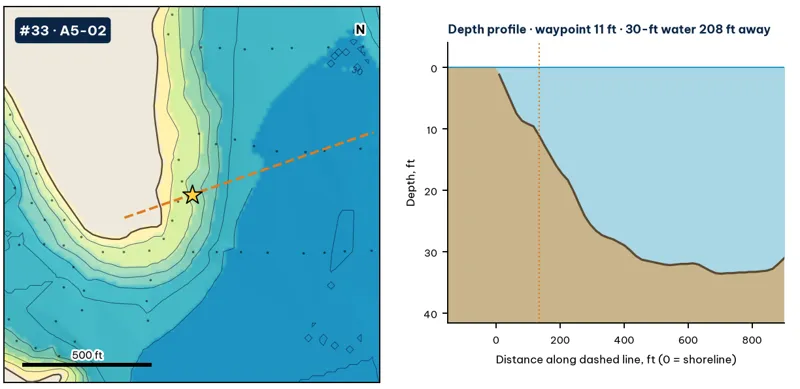
Star: target waypoint. Dashed orange line: the profile on the right. Black dots: OWRB 1999 sonar soundings. Contours every 5 ft from my grid of those soundings and OWRB's contours. Depths are below the 1,191-ft normal pool.
| Measure | Value |
|---|---|
| Depth at the waypoint | 11 ft analysis |
| Deep-water access | 20-ft water 95 ft away · 30-ft 208 ft · 40-ft 1737 ft · deepest within 300 ft: 32 ft analysis |
| Slope | 6.6 ft per 100 ft (10 ft to 30 ft) analysis |
| Data support | 12 soundings within 300 ft analysis |
Why a giant would use it. A main-lake point with 30-ft water close to the bank. Points are the natural highways between the deep channel and the coves. Pre-spawn females stage on them, and wind-blown shad pile up on them in summer and fall. inference
How to fish it. Jerkbait and jig in pre-spawn; Texas-rigged worm and deep crankbait in summer; swimbait on windy days inference. Best wind: from the E (blowing onto the spot) analysis. Oklahoma City's prevailing wind is south to southeast for most of the year, so south-facing banks get it most often (OCS).
A5-03 · Point (SE-facing)
#40 of 40Deep water1Cover3Forage3Low pressure3Data5Best: Pre-spawn · Spawn · Fall
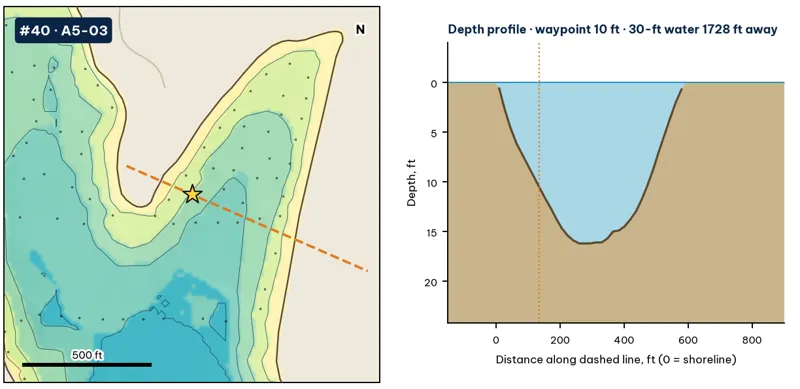
Star: target waypoint. Dashed orange line: the profile on the right. Black dots: OWRB 1999 sonar soundings. Contours every 5 ft from my grid of those soundings and OWRB's contours. Depths are below the 1,191-ft normal pool.
| Measure | Value |
|---|---|
| Depth at the waypoint | 10 ft analysis |
| Deep-water access | 20-ft water 318 ft away · 30-ft 1728 ft · 40-ft 3519 ft · deepest within 300 ft: 20 ft analysis |
| Slope | ridge top to 60 ft within about 450 ft analysis |
| Data support | 16 soundings within 300 ft analysis |
Why a giant would use it. A main-lake point with 30-ft water close to the bank. Points are the natural highways between the deep channel and the coves. Pre-spawn females stage on them, and wind-blown shad pile up on them in summer and fall. inference
How to fish it. Jerkbait and jig in pre-spawn; Texas-rigged worm and deep crankbait in summer; swimbait on windy days inference. Best wind: from the SE (blowing onto the spot) analysis. Oklahoma City's prevailing wind is south to southeast for most of the year, so south-facing banks get it most often (OCS).