Area 3 · Main Channel & SW Arm
The old East Elm Creek channel up the middle of the lake, the offshore ridge where two channels meet, and the southwest arm below the Southwest ramp. analysis
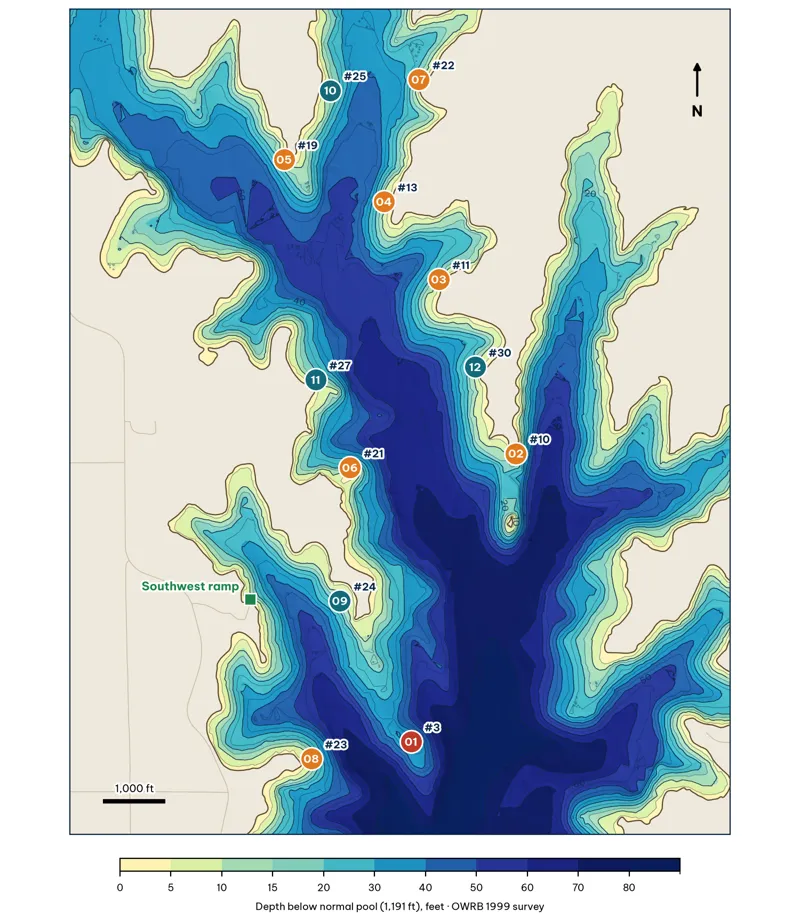
Area 3. Badge number = spot ID within the area; "#" = lake-wide giant rank. Red = score 80+, orange = 70–79, teal = under 70. Contours every 10 ft (labeled) from the OWRB 1999 survey grid.
Area 3 Spots: Main Channel & SW Arm
12 spots: A3-01, A3-02, A3-03, A3-04, A3-05, A3-06, A3-07, A3-08, A3-09, A3-10, A3-11, A3-12. Close-up maps from the OWRB 1999 survey; scores from the giant ranking.
A3-01 · Main-basin ridge
#3 of 40Deep water5Cover4Forage4Low pressure3Data3Best: Winter · Pre-spawn · Summer
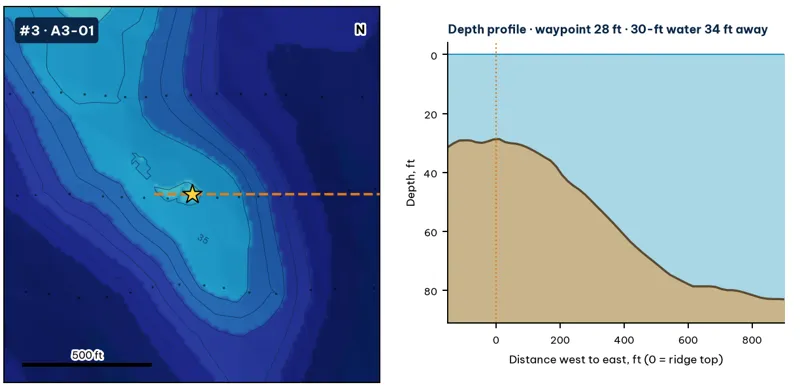
Star: target waypoint. Dashed orange line: the profile on the right. Black dots: OWRB 1999 sonar soundings. Contours every 5 ft from my grid of those soundings and OWRB's contours. Depths are below the 1,191-ft normal pool.
| Measure | Value |
|---|---|
| Depth at the waypoint | 28 ft analysis |
| Deep-water access | 20-ft water 0 ft away · 30-ft 34 ft · 40-ft 159 ft · deepest within 300 ft: 66 ft analysis |
| Slope | ridge top to 60 ft within about 450 ft analysis |
| Data support | 7 soundings within 300 ft analysis |
Why a giant would use it. An offshore ridge where two old channels meet, with a top near 29 ft and 60+ ft on either side. Offshore structure like this is where big, lightly pressured bass school on shad in summer and winter. Few bank anglers can reach it. inference
How to fish it. Football jig or Carolina rig on top; big swimbait or flutter spoon over it when shad are on the graph inference. Wind: offshore, so any wind that positions shad over the ridge helps. Use the trolling motor's spot-lock or a marker buoy analysis.
A3-02 · Point (SE-facing)
#10 of 40Deep water4Cover3Forage4Low pressure4Data4Best: Pre-spawn · Summer
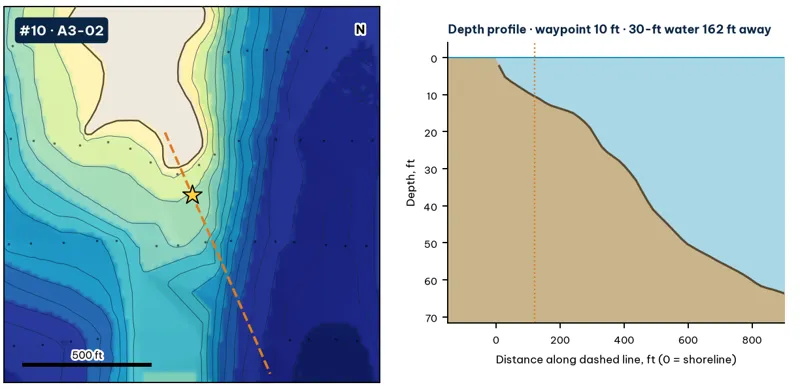
Star: target waypoint. Dashed orange line: the profile on the right. Black dots: OWRB 1999 sonar soundings. Contours every 5 ft from my grid of those soundings and OWRB's contours. Depths are below the 1,191-ft normal pool.
| Measure | Value |
|---|---|
| Depth at the waypoint | 10 ft analysis |
| Deep-water access | 20-ft water 105 ft away · 30-ft 162 ft · 40-ft 215 ft · deepest within 300 ft: 57 ft analysis |
| Slope | 6.6 ft per 100 ft (10 ft to 30 ft) analysis |
| Data support | 9 soundings within 300 ft analysis |
Why a giant would use it. A main-lake point with 30-ft water close to the bank. Points are the natural highways between the deep channel and the coves. Pre-spawn females stage on them, and wind-blown shad pile up on them in summer and fall. inference
How to fish it. Jerkbait and jig in pre-spawn; Texas-rigged worm and deep crankbait in summer; swimbait on windy days inference. Best wind: from the SE (blowing onto the spot) analysis. Oklahoma City's prevailing wind is south to southeast for most of the year, so south-facing banks get it most often (OCS).
A3-03 · Point (NW-facing)
#11 of 40Deep water3Cover3Forage4Low pressure5Data5Best: Pre-spawn · Summer
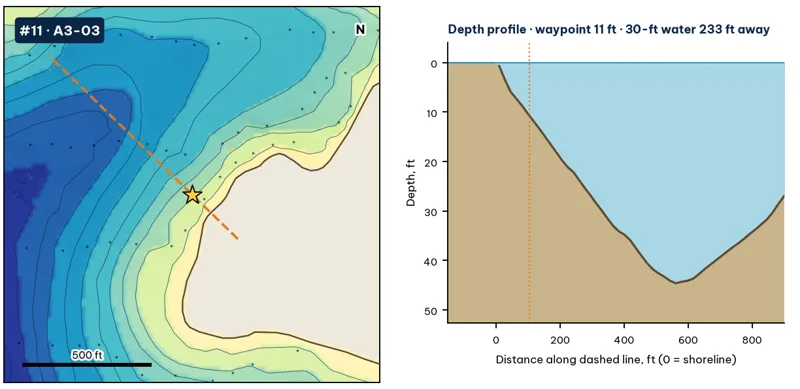
Star: target waypoint. Dashed orange line: the profile on the right. Black dots: OWRB 1999 sonar soundings. Contours every 5 ft from my grid of those soundings and OWRB's contours. Depths are below the 1,191-ft normal pool.
| Measure | Value |
|---|---|
| Depth at the waypoint | 11 ft analysis |
| Deep-water access | 20-ft water 106 ft away · 30-ft 233 ft · 40-ft 356 ft · deepest within 300 ft: 43 ft analysis |
| Slope | 8.0 ft per 100 ft (10 ft to 30 ft) analysis |
| Data support | 11 soundings within 300 ft analysis |
Why a giant would use it. A main-lake point with 30-ft water close to the bank. Points are the natural highways between the deep channel and the coves. Pre-spawn females stage on them, and wind-blown shad pile up on them in summer and fall. inference
How to fish it. Jerkbait and jig in pre-spawn; Texas-rigged worm and deep crankbait in summer; swimbait on windy days inference. Best wind: from the NW (blowing onto the spot) analysis. Oklahoma City's prevailing wind is south to southeast for most of the year, so south-facing banks get it most often (OCS).
A3-04 · Point (W-facing)
#13 of 40Deep water4Cover3Forage4Low pressure5Data4Best: Pre-spawn · Summer
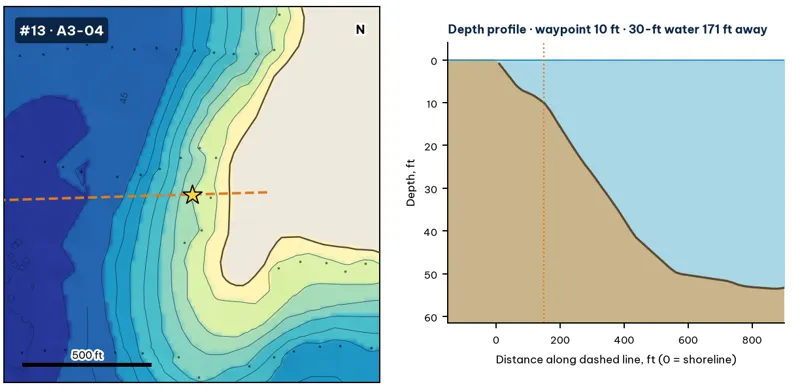
Star: target waypoint. Dashed orange line: the profile on the right. Black dots: OWRB 1999 sonar soundings. Contours every 5 ft from my grid of those soundings and OWRB's contours. Depths are below the 1,191-ft normal pool.
| Measure | Value |
|---|---|
| Depth at the waypoint | 10 ft analysis |
| Deep-water access | 20-ft water 81 ft away · 30-ft 171 ft · 40-ft 248 ft · deepest within 300 ft: 46 ft analysis |
| Slope | 10.2 ft per 100 ft (10 ft to 30 ft) analysis |
| Data support | 8 soundings within 300 ft analysis |
Why a giant would use it. A main-lake point with 30-ft water close to the bank. Points are the natural highways between the deep channel and the coves. Pre-spawn females stage on them, and wind-blown shad pile up on them in summer and fall. inference
How to fish it. Jerkbait and jig in pre-spawn; Texas-rigged worm and deep crankbait in summer; swimbait on windy days inference. Best wind: from the W (blowing onto the spot) analysis. Oklahoma City's prevailing wind is south to southeast for most of the year, so south-facing banks get it most often (OCS).
A3-05 · Point (SW-facing)
#19 of 40Deep water4Cover3Forage4Low pressure4Data3Best: Pre-spawn · Summer
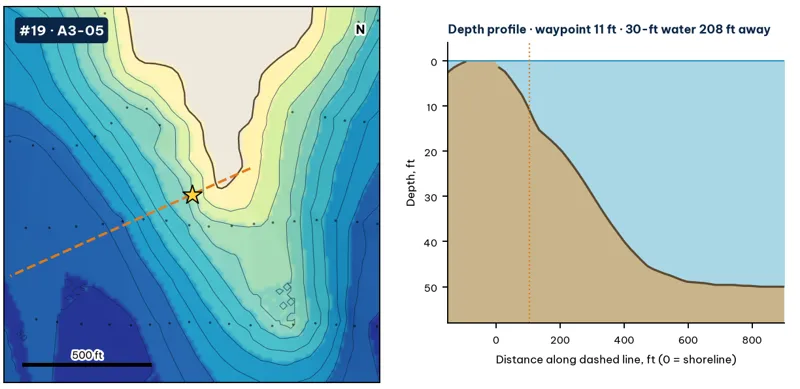
Star: target waypoint. Dashed orange line: the profile on the right. Black dots: OWRB 1999 sonar soundings. Contours every 5 ft from my grid of those soundings and OWRB's contours. Depths are below the 1,191-ft normal pool.
| Measure | Value |
|---|---|
| Depth at the waypoint | 11 ft analysis |
| Deep-water access | 20-ft water 106 ft away · 30-ft 208 ft · 40-ft 304 ft · deepest within 300 ft: 46 ft analysis |
| Slope | 9.4 ft per 100 ft (10 ft to 30 ft) analysis |
| Data support | 7 soundings within 300 ft analysis |
Why a giant would use it. A main-lake point with 30-ft water close to the bank. Points are the natural highways between the deep channel and the coves. Pre-spawn females stage on them, and wind-blown shad pile up on them in summer and fall. inference
How to fish it. Jerkbait and jig in pre-spawn; Texas-rigged worm and deep crankbait in summer; swimbait on windy days inference. Best wind: from the SW (blowing onto the spot) analysis. Oklahoma City's prevailing wind is south to southeast for most of the year, so south-facing banks get it most often (OCS).
A3-06 · Point (NE-facing)
#21 of 40Deep water4Cover3Forage4Low pressure3Data4Best: Pre-spawn · Summer
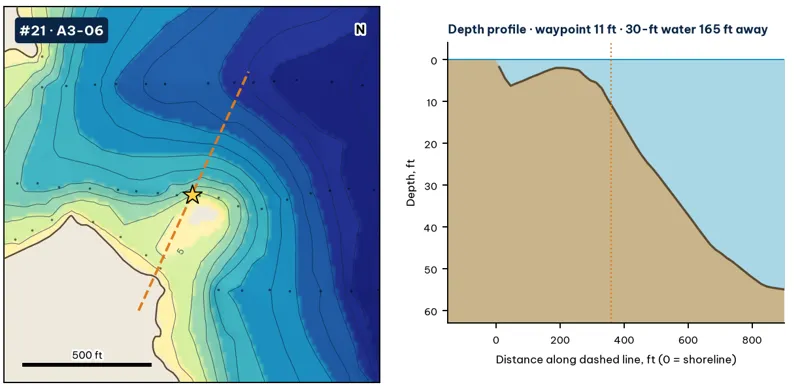
Star: target waypoint. Dashed orange line: the profile on the right. Black dots: OWRB 1999 sonar soundings. Contours every 5 ft from my grid of those soundings and OWRB's contours. Depths are below the 1,191-ft normal pool.
| Measure | Value |
|---|---|
| Depth at the waypoint | 11 ft analysis |
| Deep-water access | 20-ft water 54 ft away · 30-ft 165 ft · 40-ft 262 ft · deepest within 300 ft: 50 ft analysis |
| Slope | 11.2 ft per 100 ft (10 ft to 30 ft) analysis |
| Data support | 8 soundings within 300 ft analysis |
Why a giant would use it. A main-lake point with 30-ft water close to the bank. Points are the natural highways between the deep channel and the coves. Pre-spawn females stage on them, and wind-blown shad pile up on them in summer and fall. inference
How to fish it. Jerkbait and jig in pre-spawn; Texas-rigged worm and deep crankbait in summer; swimbait on windy days inference. Best wind: from the NE (blowing onto the spot) analysis. Oklahoma City's prevailing wind is south to southeast for most of the year, so south-facing banks get it most often (OCS).
A3-07 · Point (NW-facing)
#22 of 40Deep water3Cover3Forage3Low pressure4Data4Best: Pre-spawn · Summer
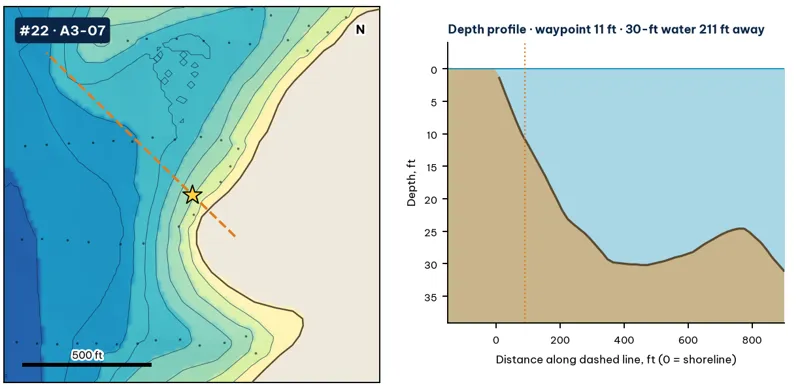
Star: target waypoint. Dashed orange line: the profile on the right. Black dots: OWRB 1999 sonar soundings. Contours every 5 ft from my grid of those soundings and OWRB's contours. Depths are below the 1,191-ft normal pool.
| Measure | Value |
|---|---|
| Depth at the waypoint | 11 ft analysis |
| Deep-water access | 20-ft water 95 ft away · 30-ft 211 ft · 40-ft 648 ft · deepest within 300 ft: 35 ft analysis |
| Slope | 6.2 ft per 100 ft (10 ft to 30 ft) analysis |
| Data support | 10 soundings within 300 ft analysis |
Why a giant would use it. A main-lake point with 30-ft water close to the bank. Points are the natural highways between the deep channel and the coves. Pre-spawn females stage on them, and wind-blown shad pile up on them in summer and fall. inference
How to fish it. Jerkbait and jig in pre-spawn; Texas-rigged worm and deep crankbait in summer; swimbait on windy days inference. Best wind: from the NW (blowing onto the spot) analysis. Oklahoma City's prevailing wind is south to southeast for most of the year, so south-facing banks get it most often (OCS).
A3-08 · Point (NE-facing)
#23 of 40Deep water4Cover3Forage4Low pressure3Data3Best: Pre-spawn · Summer
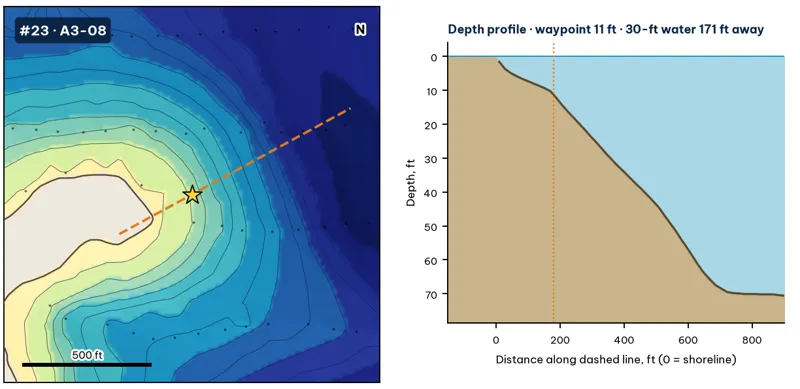
Star: target waypoint. Dashed orange line: the profile on the right. Black dots: OWRB 1999 sonar soundings. Contours every 5 ft from my grid of those soundings and OWRB's contours. Depths are below the 1,191-ft normal pool.
| Measure | Value |
|---|---|
| Depth at the waypoint | 11 ft analysis |
| Deep-water access | 20-ft water 76 ft away · 30-ft 171 ft · 40-ft 280 ft · deepest within 300 ft: 52 ft analysis |
| Slope | 10.2 ft per 100 ft (10 ft to 30 ft) analysis |
| Data support | 7 soundings within 300 ft analysis |
Why a giant would use it. A main-lake point with 30-ft water close to the bank. Points are the natural highways between the deep channel and the coves. Pre-spawn females stage on them, and wind-blown shad pile up on them in summer and fall. inference
How to fish it. Jerkbait and jig in pre-spawn; Texas-rigged worm and deep crankbait in summer; swimbait on windy days inference. Best wind: from the NE (blowing onto the spot) analysis. Oklahoma City's prevailing wind is south to southeast for most of the year, so south-facing banks get it most often (OCS).
A3-09 · Point (S-facing)
#24 of 40Deep water3Cover3Forage4Low pressure2Data5Best: Pre-spawn · Summer
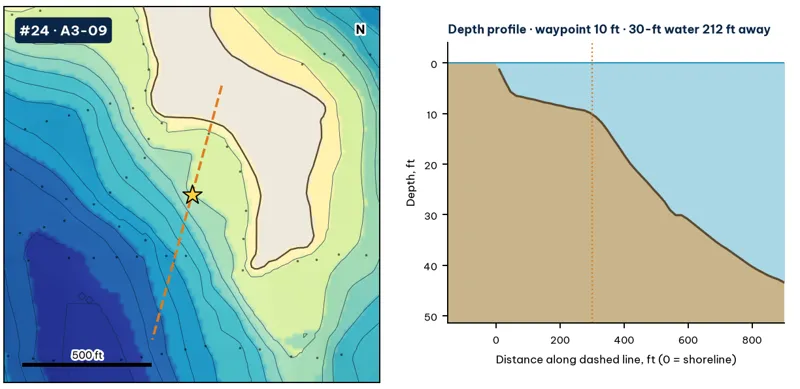
Star: target waypoint. Dashed orange line: the profile on the right. Black dots: OWRB 1999 sonar soundings. Contours every 5 ft from my grid of those soundings and OWRB's contours. Depths are below the 1,191-ft normal pool.
| Measure | Value |
|---|---|
| Depth at the waypoint | 10 ft analysis |
| Deep-water access | 20-ft water 87 ft away · 30-ft 212 ft · 40-ft 318 ft · deepest within 300 ft: 46 ft analysis |
| Slope | 8.0 ft per 100 ft (10 ft to 30 ft) analysis |
| Data support | 11 soundings within 300 ft analysis |
Why a giant would use it. A main-lake point with 30-ft water close to the bank. Points are the natural highways between the deep channel and the coves. Pre-spawn females stage on them, and wind-blown shad pile up on them in summer and fall. inference
How to fish it. Jerkbait and jig in pre-spawn; Texas-rigged worm and deep crankbait in summer; swimbait on windy days inference. Best wind: from the S (blowing onto the spot) analysis. Oklahoma City's prevailing wind is south to southeast for most of the year, so south-facing banks get it most often (OCS).
A3-10 · Bank bend (E-facing)
#25 of 40Deep water3Cover2Forage4Low pressure4Data4Best: Pre-spawn
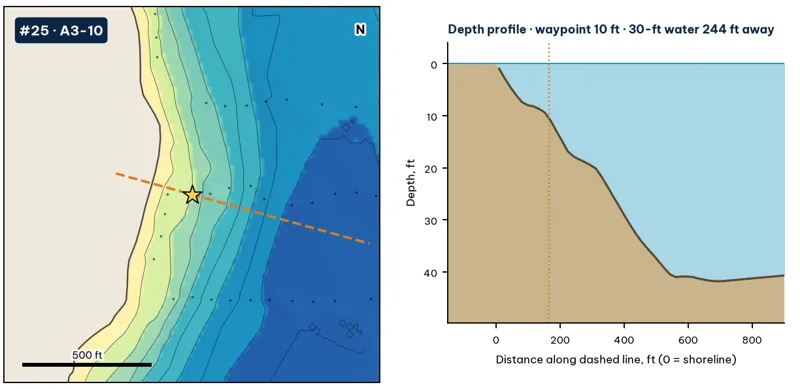
Star: target waypoint. Dashed orange line: the profile on the right. Black dots: OWRB 1999 sonar soundings. Contours every 5 ft from my grid of those soundings and OWRB's contours. Depths are below the 1,191-ft normal pool.
| Measure | Value |
|---|---|
| Depth at the waypoint | 10 ft analysis |
| Deep-water access | 20-ft water 148 ft away · 30-ft 244 ft · 40-ft 370 ft · deepest within 300 ft: 40 ft analysis |
| Slope | 8.0 ft per 100 ft (10 ft to 30 ft) analysis |
| Data support | 9 soundings within 300 ft analysis |
Why a giant would use it. A bend or secondary point where the bank swings toward the channel. The break tightens here, which concentrates fish moving along the bank. inference
How to fish it. Jig, shaky head or Texas rig worked down the break; squarebill over the top at dawn inference. Best wind: from the E (blowing onto the spot) analysis. Oklahoma City's prevailing wind is south to southeast for most of the year, so south-facing banks get it most often (OCS).
A3-11 · Point (NE-facing)
#27 of 40Deep water3Cover3Forage4Low pressure3Data4Best: Pre-spawn · Summer
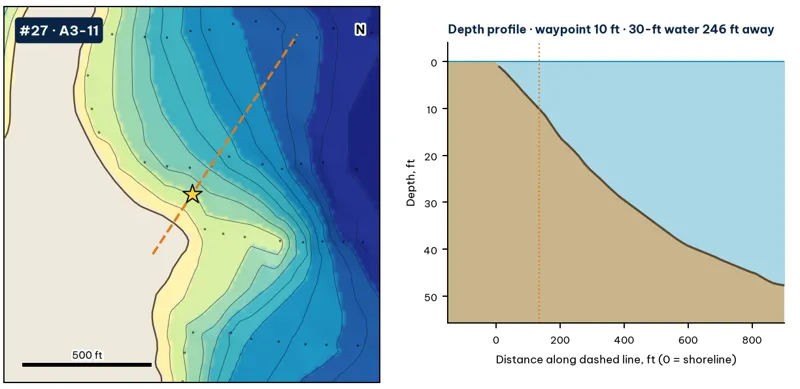
Star: target waypoint. Dashed orange line: the profile on the right. Black dots: OWRB 1999 sonar soundings. Contours every 5 ft from my grid of those soundings and OWRB's contours. Depths are below the 1,191-ft normal pool.
| Measure | Value |
|---|---|
| Depth at the waypoint | 10 ft analysis |
| Deep-water access | 20-ft water 127 ft away · 30-ft 246 ft · 40-ft 396 ft · deepest within 300 ft: 38 ft analysis |
| Slope | 7.0 ft per 100 ft (10 ft to 30 ft) analysis |
| Data support | 8 soundings within 300 ft analysis |
Why a giant would use it. A main-lake point with 30-ft water close to the bank. Points are the natural highways between the deep channel and the coves. Pre-spawn females stage on them, and wind-blown shad pile up on them in summer and fall. inference
How to fish it. Jerkbait and jig in pre-spawn; Texas-rigged worm and deep crankbait in summer; swimbait on windy days inference. Best wind: from the NE (blowing onto the spot) analysis. Oklahoma City's prevailing wind is south to southeast for most of the year, so south-facing banks get it most often (OCS).
A3-12 · Point (NW-facing)
#30 of 40Deep water3Cover3Forage4Low pressure4Data3Best: Pre-spawn
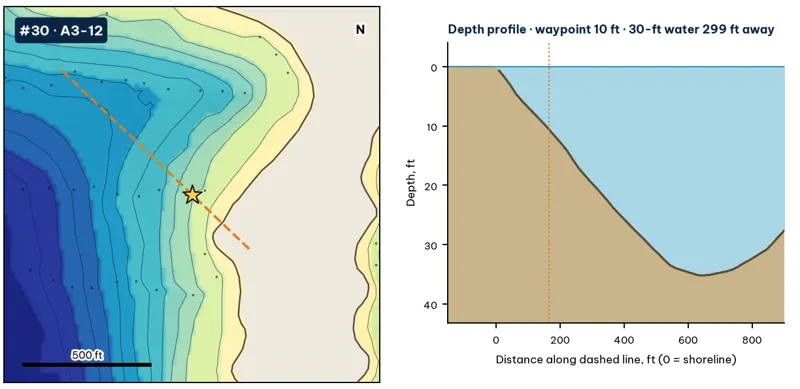
Star: target waypoint. Dashed orange line: the profile on the right. Black dots: OWRB 1999 sonar soundings. Contours every 5 ft from my grid of those soundings and OWRB's contours. Depths are below the 1,191-ft normal pool.
| Measure | Value |
|---|---|
| Depth at the waypoint | 10 ft analysis |
| Deep-water access | 20-ft water 114 ft away · 30-ft 299 ft · 40-ft 406 ft · deepest within 300 ft: 35 ft analysis |
| Slope | 6.2 ft per 100 ft (10 ft to 30 ft) analysis |
| Data support | 6 soundings within 300 ft analysis |
Why a giant would use it. A main-lake point with 30-ft water close to the bank. Points are the natural highways between the deep channel and the coves. Pre-spawn females stage on them, and wind-blown shad pile up on them in summer and fall. inference
How to fish it. Jerkbait and jig in pre-spawn; Texas-rigged worm and deep crankbait in summer; swimbait on windy days inference. Best wind: from the NW (blowing onto the spot) analysis. Oklahoma City's prevailing wind is south to southeast for most of the year, so south-facing banks get it most often (OCS).